Joe Brody tries to take over Geiger's racket and extort the Sternwoods
The Big SleepJoe Brody’s attempt to take over Arthur Geiger’s illicit book-lending business and extort the Sternwood family turns Geiger’s disappearance into an opportunity: Brody moves the stock, obtains Carmen Sternwood’s compromising photograph, and demands five thousand dollars from Vivian Regan. The scheme exposes the business’s underlying value and brings Brody into direct conflict with Philip Marlowe, but it ends with Brody’s death and a public account that conceals much of what happened.
Opportunity in Geiger’s absence
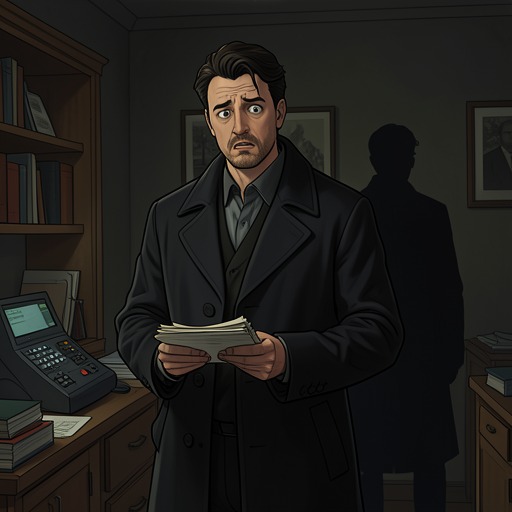
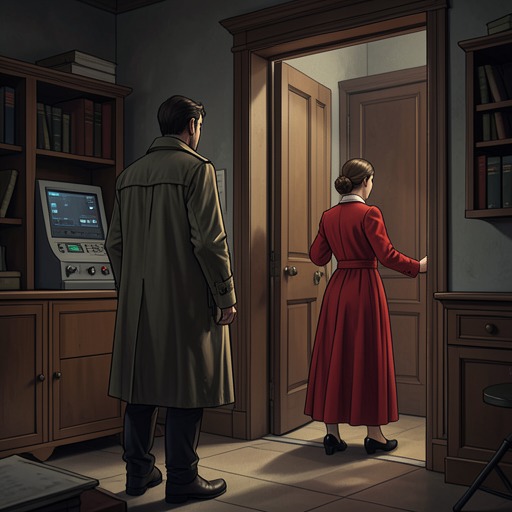
After seeing boxes of books being moved from Geiger’s store, Philip Marlowe follows the removal operation to Randall Place. There he finds the truck in the basement garage of an apartment building and sees that Joseph Brody has an apartment there. The address links the transfer to a man whom General Guy Sternwood had previously paid five thousand dollars to stop pursuing Carmen Sternwood and leave town. Marlowe suspects that the Joseph Brody listed at the building may be the same Joe Brody, connecting the new movement of Geiger’s stock to an older history of dealings with the Sternwood family.
The circumstances give Brody an opening. Geiger has not appeared at the store or answered his telephone, while the books are being removed before anyone can establish what has happened. Brody later acknowledges that, after learning Geiger had not returned, he considered it a good moment to move the books and make a quick demand on the Sternwoods for money to travel and leave town. His stated plan joins two forms of appropriation: taking over the inventory and turning the family’s vulnerability into cash.
The books as a business
Marlowe understands that the books are not merely boxes of stock but the equipment and records of an operating rental business. One volume he examines is heavily illustrated, handsomely printed, and marked with dates showing when it was borrowed and returned. The stamps identify it as a rental book, evidence of a lending library rather than a conventional retail operation. Its open presence on the boulevard also suggests to Marlowe that the operation enjoys substantial protection.
When Brody confronts him with a gun, Marlowe argues that the business could be worth far more than the small number of boxes Brody has removed. He estimates that Geiger’s coded list contains about five hundred names and that the known boxes represent only part of a stock that should total about five hundred books, with additional copies still on loan. If the list could be worked at half its capacity, Marlowe calculates, it would produce roughly 125,000 rentals; at a dollar per rental, that would amount to $125,000 while leaving the original capital intact. The calculation is explicitly an estimate, but it makes clear why control of the inventory and customer list could tempt Brody beyond a one-time theft.
Extortion through Carmen’s photograph
Brody’s leverage against the family rests on an image of Carmen in Geiger’s house. Vivian shows Marlowe a photograph delivered in a thick white envelope addressed to her at Alta Brea Crescent. The messenger-service stamp records an 8:35 a.m. dispatch time. The photograph depicts Carmen seated in Geiger’s high-backed chair, and Marlowe recognizes her from the crime scene. Its arrival makes the threat immediate: whoever has the image can connect the Sternwood family to Geiger’s illicit operation and expose Carmen to public scandal.
The demand is five thousand dollars in exchange for the negative and the remaining prints. Vivian reports that the ultimatum must be settled that night or the material will be given to a scandal sheet; a woman delivered the demand by telephone about half an hour after the envelope arrived. The photograph therefore functions as both evidence and a means of coercion. Brody’s plan is not simply to extract money from a wealthy household: it depends on the family’s need to prevent Carmen’s image from becoming public.
Confrontation and collapse
In the confrontation at Brody’s apartment, Marlowe presents the coded customer list and the book stock as assets Brody has not yet fully understood. Brody’s position is precarious: he has removed books, is holding the photograph, and is trying to use the Sternwoods’ fear of exposure to finance his departure. Marlowe’s estimate of the rental business challenges Brody’s assumption that the immediate extortion is the whole opportunity, while the gun and the threatened possibility of violence reveal how quickly the commercial scheme becomes dangerous.
Brody later describes what he says happened after Geiger was shot. He claims he heard the shots, saw the killer leave in a Buick, followed him, and took a plateholder from the car after stopping the driver. The driver, he says, regained consciousness and knocked him down. Brody says the developed plate made him nearly certain that Geiger had been the victim, and Geiger’s failure to appear or answer the phone strengthened his suspicion. He presents these claims as the reason he moved the books and made his demand; his account does not establish that he killed Geiger.
Brody’s attempt ends when Carol Lundgren kills him. The subsequent newspaper version says that Brody shot Geiger and that Lundgren shot Brody in revenge, while reporting that Lundgren has confessed and that Agnes Lozelle is being held as a material witness. That account compresses the events into a straightforward sequence that does not match the fuller circumstances Marlowe knows. Captain Cronjager receives credit for solving both killings, and the report omits the Sternwoods and Marlowe. Brody’s death thus closes his bid for the racket while leaving his role, and the surrounding concealment, embedded in an official story that redirects responsibility.